Showing posts with label age spots. Show all posts
Showing posts with label age spots. Show all posts
Tuesday, February 7, 2017

Saturday, September 19, 2015
Sun Damage, Age Spots & Dark Spots
The sun is the number one cause of signs of aging, wrinkles, brown spots, dull skin and cancer. Over 90% of all visible changes to the skin typically attributed to aging are actually caused by sun exposure.
 A major source dark spots, often called age spots, are caused from sun exposure not as a direct result of age. To make matters worse, sun damage is cumulative. The older you get, the more sun damage you accumulate. Sun damage can manifest on the skin 20-30 years down the line.
We all know that excessive sun exposure is bad for your health - the 'healthy glow' people seek every summer contributes to the long-term damage of your skin. However, studies have proven that sun exposure also makes you look older. A 2006 study conducted by Proctor & Gamble showed that skin tone can affect a person's perceived age by as much as 20 years. Sun exposure causes photo-aging, the deterioration of the skin from harmful UV rays.
Sun exposure causes photo-aging, the deterioration of the skin from harmful UV rays. The effects of sun damage include:
When skin is exposed to UV light, melanin is produced by specialized cells called melanocytes. The production of melanin is the body's defense against sun damage - melanin is able to disperse about 99.9% of absorbed UV radiation. In some areas of the skin, the concentration of cells may vary - dense amounts of cells can create melanin “deposits,” causing dark spots. As we age, our cells become less diffuse and this defense mechanism becomes less effective, so dark spots become a more frequent occurrence.
Thankfully, there are ways to counteract the signs of aging caused by sun damage. Lightening creams, advanced skin care and Med Spa services such as IPL photo facials, microdermabrasion, chemical peels and high frequency treatments can help rejuvenate the skin.
Next, will discuss these treatments in depth and explain how they can help sun damaged skin. Until then, don't forget to wear your sun screen!
 A major source dark spots, often called age spots, are caused from sun exposure not as a direct result of age. To make matters worse, sun damage is cumulative. The older you get, the more sun damage you accumulate. Sun damage can manifest on the skin 20-30 years down the line.
 We all know that excessive sun exposure is bad for your health - the 'healthy glow' people seek every summer contributes to the long-term damage of your skin. However, studies have proven that sun exposure also makes you look older. A 2006 study conducted by Proctor & Gamble showed that skin tone can affect a person's perceived age by as much as 20 years. Sun exposure causes photo-aging, the deterioration of the skin from harmful UV rays.
Sun exposure causes photo-aging, the deterioration of the skin from harmful UV rays. The effects of sun damage include:
- Dark Spots or a blotchy, mottled complexion
- Premature Lines and Wrinkles
- Telangiectasias, the dilation of blood vessels under the skin, or broken capillaries
- Elastosis, the deterioration of collagen and elastin that causes the skin to sag
- Thinning Skin and Changes in Skin Texture
- Pre-cancerous and cancerous skin lesions
When skin is exposed to UV light, melanin is produced by specialized cells called melanocytes. The production of melanin is the body's defense against sun damage - melanin is able to disperse about 99.9% of absorbed UV radiation. In some areas of the skin, the concentration of cells may vary - dense amounts of cells can create melanin “deposits,” causing dark spots. As we age, our cells become less diffuse and this defense mechanism becomes less effective, so dark spots become a more frequent occurrence.
Thankfully, there are ways to counteract the signs of aging caused by sun damage. Lightening creams, advanced skin care and Med Spa services such as IPL photo facials, microdermabrasion, chemical peels and high frequency treatments can help rejuvenate the skin.
Next, will discuss these treatments in depth and explain how they can help sun damaged skin. Until then, don't forget to wear your sun screen!
Saturday, June 13, 2015
What causes Melasma, Hyperpigmentation or Dark Spots?
Hyperpigmentation, or dark spots, can be triggered by several different factors. While sun exposure is a major cause, other issues like hormonal changes and acne can lead to hyperpigmentation.
Melasma is a type of hyperpigmentation that is linked to hormonal changes. Melasma is characterized by dark, irregular discoloration ranging in size from freckles to large patches. These dark spots are usually found on the upper cheeks, upper lip, forehead and nose. Melasma very common in pregnant women, in fact its often called ‘the mask of pregnancy.”
Hormone shifts triggered by birth control pills, pregnancy, thyroid conditions and menopause are the most common causes of melasma. Hormonal changes can cause melanin production to spike. Melasma is thought to occur when melanocytes, the cells that produce melanin, are stimulated by female hormones such as estrogen and progesterone. This hormonal stimulation causes melanin to produce more pigments when exposed to sunlight.
Both men and women can develop melasma, however its much more common in women. Some people may be genetically predisposed to developing melasma. People with darker skin such as African, African American, Asian, Indian, Latin/Hispanic, Mediterranean and Middle Eastern descent are more prone to hyperpigmentation and melasma. This is because the melanocytes are more active in darker skin tones.
There are three types of melasma:
All cases of melasma start out in the epidermis, the outermost layer of skin. Dermal melasma occurs when the affected cells are inflamed or over irritated. Inflammation can cause a temporary split between the dermis and epidermis allowing cells from melasma drop from the epidermis into the dermis. Once in the dermis, melasma is very difficult to treat because the cells become resistant to topical treatments.
 |
| source |
Hormone shifts triggered by birth control pills, pregnancy, thyroid conditions and menopause are the most common causes of melasma. Hormonal changes can cause melanin production to spike. Melasma is thought to occur when melanocytes, the cells that produce melanin, are stimulated by female hormones such as estrogen and progesterone. This hormonal stimulation causes melanin to produce more pigments when exposed to sunlight.
Both men and women can develop melasma, however its much more common in women. Some people may be genetically predisposed to developing melasma. People with darker skin such as African, African American, Asian, Indian, Latin/Hispanic, Mediterranean and Middle Eastern descent are more prone to hyperpigmentation and melasma. This is because the melanocytes are more active in darker skin tones.
- Epidermal melasma
- occurs in superficial layers of the skin
- well-defined borders
- typically dark brown in color
- responds very well to treatment
- Dermal melasma
- occurs in deeper layers of the skin
- undefined borders
- light brown or blueish in color
- Mixed melasma
- a combination of epidermal and dermal melasma
- most common type of melasma
- mix of light brown, dark brown and blueish in color
All cases of melasma start out in the epidermis, the outermost layer of skin. Dermal melasma occurs when the affected cells are inflamed or over irritated. Inflammation can cause a temporary split between the dermis and epidermis allowing cells from melasma drop from the epidermis into the dermis. Once in the dermis, melasma is very difficult to treat because the cells become resistant to topical treatments.
Friday, June 5, 2015
How Does Sun Damage Affect Your Skin?
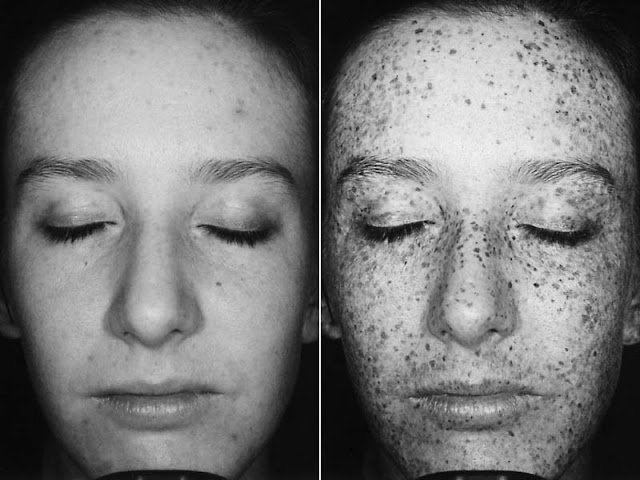
Sun damage is the major cause of hyperpigmentation - even spots from melasma, post inflammatory or other damage is exacerbated by sun damage. In addition to hyper pigmentation sun damage can cause:
About 80% of a person's lifetime sun exposure is acquired by the age of 18 - but it's never too early or too late to take care your skin. A few things you can do to prevent sun damage are:
 While prevention is always best, there are things you can do to help repair and correct damage from sun exposure. A few simple changes to your beauty routine and a day at the spa can help you turn back the clock.
Tips to help repair sun damage:
- Wrinkles
- Dry or rough textured skin
- Broken capillaries
- Freckles
- Macules or dark spots
- A weakening of the connective tissues of your face which reduces elasticity.
 |
| source |
About 80% of a person's lifetime sun exposure is acquired by the age of 18 - but it's never too early or too late to take care your skin. A few things you can do to prevent sun damage are:
- Wear a sunblock or sunscreen of at least SPF30 and diligently reapply every 2-3 hours
- Wear protective clothing, hats and sunglasses
- Choose make-up and skin care products with additional UV protection
- Limit your sun exposure at peak hours- 10 am to 2pm

Tips to help repair sun damage:
- Wear sunscreen! Consistent sunscreen use will prevent further damage and allow your skin to recover.
- Hydrate - Keep your body and your skin hydrated by drinking plenty of water and using a good moisturizer. Wrinkles and fine lines look deeper on dehydrated skin!
- Exfoliate - Chemical exfoliation dissolves and sloughs off dead, dull skin more evenly than a manual exfoliate like a loofah or scrubbing beads. Exfoliation will brighten the skin and prime it for any treatments you apply afterwards.
- Try spa treatments such as:
- Lightening treatments- skin lightening creams like hydroquinone and retinols can help lighten the dark spots and hyperpigmentation
- IPL Photo Facials - IPL photo facials help improve dark spots, broken capillaries, skin texture, wrinkles and other signs of sun damage
- High Frequency Technology - High Frequency treatments remove dark spots, broken capillaries, spider veins and other minor skin irregularities
Thursday, May 7, 2015
What is hyperpigmentation or Dark Spots?
Hyperpigmentation is a condition where small patches of skin become darker in tone than the rest of the body. Hyper pigmentation is caused by excess production of melanin - the natural pigment that gives our skin, hair and eyes pigmentation.
Melanin is produced by specialized cells called melanocytes and is stimulated by UV light. When skin is exposed to sunlight, melanin is able to disperse over 99.9% of the absorbed UV radiation causing the skin to tan and protecting the skin cells from damage. In some areas of the skin, the concentration of cells may vary - dense amounts of cells can create melanin “deposits,” causing dark spots. As we age, our cells become less diffuse and our skin becomes more susceptible to dark spots.
The biggest defense against hyper pigmentation is sunscreen. Because dark spots are generally caused by a reaction to the sun, sunscreen is going to help minimize that stimulation of melanocytes - preventing new spots and inhibiting existing dark spots from getting darker.

Melanin is produced by specialized cells called melanocytes and is stimulated by UV light. When skin is exposed to sunlight, melanin is able to disperse over 99.9% of the absorbed UV radiation causing the skin to tan and protecting the skin cells from damage. In some areas of the skin, the concentration of cells may vary - dense amounts of cells can create melanin “deposits,” causing dark spots. As we age, our cells become less diffuse and our skin becomes more susceptible to dark spots.
The biggest defense against hyper pigmentation is sunscreen. Because dark spots are generally caused by a reaction to the sun, sunscreen is going to help minimize that stimulation of melanocytes - preventing new spots and inhibiting existing dark spots from getting darker.

Subscribe to:
Comments (Atom)